Fakultät für
Wirtschaftsingenieurwesen
International Management and Digital Engineering (B.Eng.)
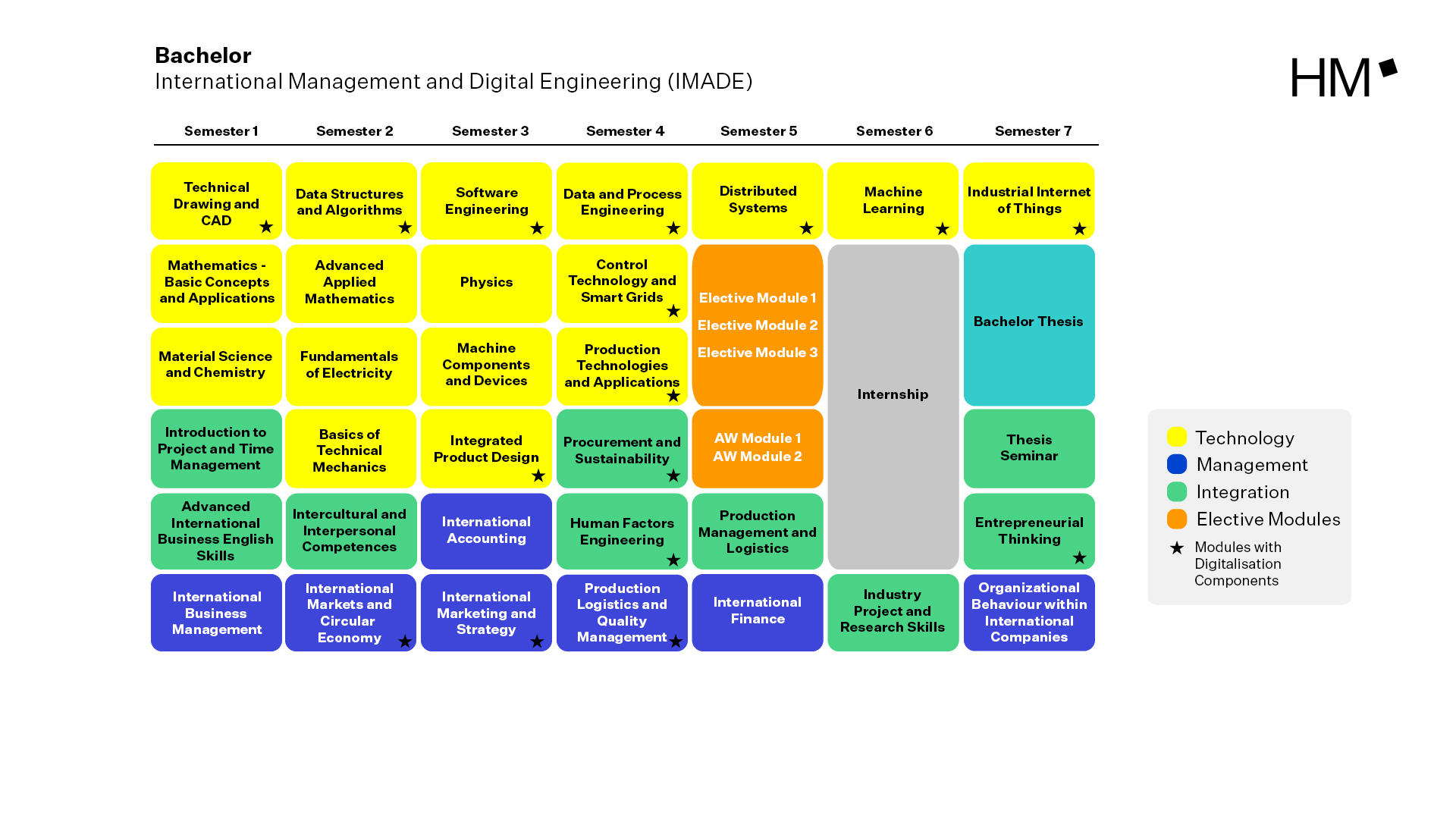
This program is designed with a modular structure, consisting of six semesters focused on theoretical knowledge and one practical semester.
The curriculum incorporates a significant share of technical modules, a robust education in business economics, and an array of integration modules that impart comprehensive and cohesive skills. Students have the opportunity to tailor their educational focus by choosing from a variety of elective modules and general studies (AW) modules, in addition to following the core curriculum with emphases on internationalization and digitalization.
Details
- Abschluss
- Bachelor
- Studienart
- Vollzeit
- Fakultät/en
- FK09
- Studienbeginn
- Wintersemester
- Regelstudienzeit
- 7 Semester (Vollzeit)
- Zu erreichende ECTS
- 210 ECTS-Punkte
- Studienort
- Campus Lothstraße, 80335 München
- Zulassungsvoraussetzungen
-
- General higher education entrance qualification
- Advanced technical college entrance qualification
- Subject-specific university entrance qualification
- Leaving the profession
- Graduates of a further vocational training examination (master craftsmen, technicians and equivalent)
- Professionally qualified persons (at least two years of vocational training in a field related to the intended degree programme followed by at least three years of full-time professional experience in a field related to the intended degree programme, plus passing a university entrance examination)
- English Language Skills: Level B2
- Knowledge of the German language is necessary to fully integrate into the local society. Therefore, we request a corresponding language certification on level B1 by the end of the 5th semester
- Zulassungsmodus
- zulassungsbeschränkt
- Hauptunterrichtssprache
- Englisch
- Praxis
- Praxissemester: 6. Semester, 20 Wochen
- Auslandsaufenthalt
- -
- Semestergebühren (aktuell laufendes Semester)
- Grundbeitrag für das Studierendenwerk 97,00 Euro
How to apply....
Student Counselling
Our study program provides an equal understanding of technical issues and business contexts.
In addition to the current and successfully running industrial engineering program of our department, the new IMADE program was designed to prepare students for upcoming challenges of the future. Trends such as digital transformation, internationalization, sustainability, diversity, and interdisciplinary skills, as well as the resulting transformation of industry and society, are all addressed.
As "double talents", our graduates will be well prepared where technical and business issues come together and can be found in all industries
As a student on this degree program you should bring along:
- Keen interest in technical subjects
- Mathematics and IT skills
- Basic understanding of economics
- Proficiency in Business English (Level B2)
- Analytical skills
- Communication and teamworking skills
- Intercultural competence
- Interest in technology and digital innovation
You will enjoy:
- Interdisciplinary work
- A broad-based curriculum
- A practice-oriented education
- Intercultural teams
Pushes through:
- Mathematical and technical problems
Who has a degree in this programme often works in:
- This degree program is of interest to graduates in professional fields at the interface of business and technology
As "double talents", our graduates are often found in project management, technical purchasing or sales, product management and controlling - wherever technical and business issues come together. As allrounders, all industries are open to industrial engineers.
For example:
1. Technology companies: product development, project management, technical consulting.
2. Consulting firms: business consulting with a focus on digital transformation.
3. Various start-ups
4. Financial services: Rroles in fintech or innovation management.
5. Manufacturing industry: digitalization of manufacturing processes.
6. Research and development: technology-oriented innovation projects.
After completing the Bachelor's degree in International Management and Digital Engineering, one is well-prepared for entering the professional field in practice. Equally, further qualification through a Master's degree program is possible.
Learning and Qualification Objectives
Learning and Qualification Objectives
The degree programme “International Management and Digital Engineering (IMADE)” aims to enable students to develop scientifically grounded and practice-oriented solutions for complex challenges at the interface of technology and business. This is done against the backdrop of an increasingly digitalized, international, and sustainability-oriented economic environment. The programme leads to the academic degree of Bachelor of Engineering.
Academic Qualification
Graduates acquire comprehensive technical and methodological competencies in the field of industrial engineering, particularly within digital, technological, and international contexts. The curriculum combines foundations in natural sciences and engineering with business and management knowledge, as well as current key topics such as digitalization, sustainability, and intercultural collaboration.
In particular, graduates are expected to develop the ability to design products, services, and processes through the integration of business and technological solutions as well as sustainable systems. This integration increasingly takes place within institutional, social, and digital networks involving multiple stakeholders. It also includes the conception of complex facilities and systems, their management and commercialization, as well as the leadership of demanding projects and the analysis of technical issues from a business perspective.
To address these predominantly integrative tasks within a highly complex and interconnected environment, competencies in technology, business administration, legal issues, and social communication are required. These traditionally form the core profile of industrial engineering programmes, but within IMADE they are specifically expanded to include digital, international, and sustainability-related dimensions.
At the same time, students are expected to develop the ability to independently acquire new and specialized scientific knowledge and methods in order to continuously expand the foundational competencies gained during their studies.
Qualification for Professional Employment and Personal Development
In addition to teaching scientific methods, the programme places strong emphasis on their critical reflection and application within real-world projects, partly in close cooperation with companies. As a result, students develop not only professional expertise but also social, intercultural, and personal competencies. They are prepared to act responsibly in a globalized working environment and to critically contribute to societal transformation processes.
The programme particularly focuses on the following aspects:
• Promoting teamwork, communication, and intercultural competence through project-based work in diverse teams
• Strengthening democratic awareness and responsibility through the reflection of technological and economic decisions in the context of global sustainability goals
• Supporting personal responsibility, self-directed learning, and entrepreneurial thinking, among others through modules such as Entrepreneurial Thinking and elective courses related to business development
Additional impulses are provided through the interdisciplinary General Studies (AW) modules, which foster personal development and social engagement.
IMADE combines technical, business, and social competencies while explicitly addressing digitalization, internationalization, and sustainability. These profile characteristics are systematically reflected in the module objectives, teaching organization, and assessment methods. The programme positions itself as a response to the complex demands of a globalized, digital, and sustainability-oriented labour market. The curriculum is designed to educate reflective, responsible, and interdisciplinary-minded industrial engineers.
A detailed overview of the intended learning outcomes and competency profile of the programme can be found in the Objectives–Modules Matrix
Admitted students will receive further information on enrollment with their letter of admission.
Faculty for Engineering and Management
Find more information on the German Website:
Fakultät für Wirtschaftsingenieurwesen
All information about studying can be found in the A-Z list on the Faculty of Industrial Engineering's web page:
The aim of the bachelor's program is to enable students to develop scientifically sound and practice-oriented solutions for complex tasks at the interface between technology and business. This is taking place within an increasingly digitalised, international and sustainability-oriented business world.
The program comprises approximately 40% technology, 24% management, 13% integration, 2% general science electives, 6% electives, 9% industrial internship and 6% for the bachelor’s thesis.
The bachelor’s program also provides a basis for graduate level work in a scientific application-oriented master's program.
Contact
Zentrale Studienberatung
Erstanlaufstelle
Studieninformation in der Lothstraße 34
T +49 89 1265-1121
beratung@hm.edu
Virtuelle Studieninformation
Online-Studienberatung und Terminvereinbarung
Immatrikulation
Bachelor-Studiengänge
Raum A 33/34
T +49 89 1265-5000
immatrikulation@hm.edu
Kontaktdetails und Anfahrt
Prüfung und Praktikum
Sie studieren schon an der Hochschule München und haben Fragen zu Prüfungen oder Praktikum? Dann nutzen Sie bitte die Seite www.hm.edu/pruefung-praktikum